 المساعد الذكي
جارٍ تحميل القصة…

ز
مرحبًا زائرThe Charter (Sahifah) of Madinah and organizing relations between the components of society in Year 1 after the Hijrah (1 AH)
The Charter (Sahifah) of Madinah addressed the relationship between Muslims, the Jews, and the other components of society in Madinah, and it established the principle of covenant and treaty, while preserving security and rights during the stage of building the civil society after the Hijrah.
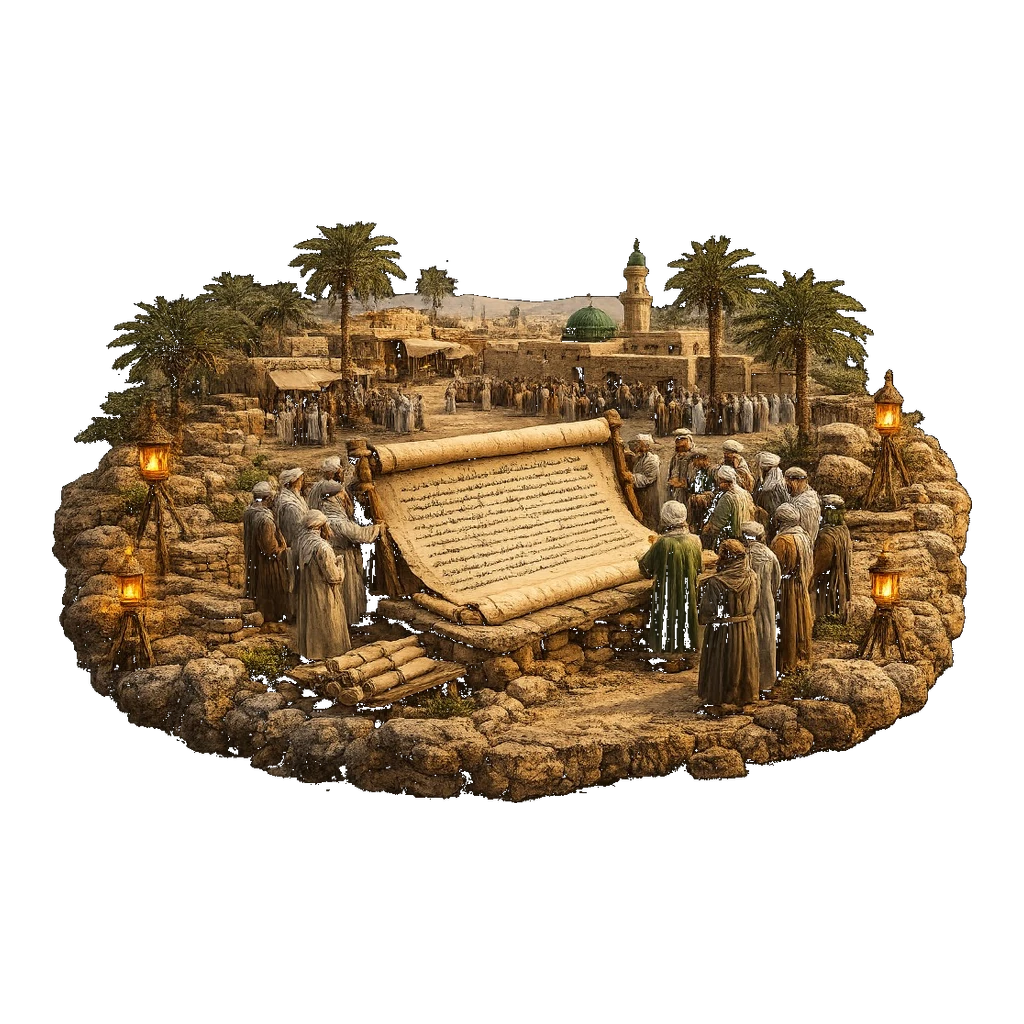
وثيقة نظّمت العلاقة بين المهاجرين والأنصار واليهود في مجتمع واحد.
The Charter (Sahifah) of Madinah addressed the relationship between Muslims, the Jews, and the other components of society in Madinah, and it established the principle of covenant and treaty, while preserving security and rights during the stage of building the civil society after the Hijrah.
It falls within the stage of building the civil community in Madinah and organizing internal relations after the Hijrah.
And in it: the Prophet ﷺ concluded a treaty with the Jews of Madinah.
What is meant is that the Prophet ﷺ established a charter that organized life together among the people of Madinah and set out the basis for cooperation, the protection of rights, and keeping the covenant.
The arrival of the Prophet ﷺ in Madinah and the building of the new community there, along with the presence of the Jews of Madinah within the town’s social and political fabric.
The need to secure internal safety and build a new community in Madinah on the basis of covenant and treaty.
The relationship with the Jews moved from a simple side-by-side social presence to one documented by covenant and treaty.
It represents one of the steps in building the civil society in Madinah.
It helps stabilize the environment in which the call to Islam spreads.
It establishes a political relationship based on covenant and charter.
It organizes coexistence among different groups within Madinah.
It teaches fulfillment of covenants and organization of relations.
It shows the community's move to a documented and organized system.
It supports the stability of Madinah in the founding stage.
Concluded the treaty
A party to the treaty
Building the Muslim community is tied to fulfilling covenants and commitment.
The importance of honesty and keeping covenants.
The possibility of organizing shared life among different groups.
The pact is a key tool in managing society.
Training the Ummah to respect agreements.
The existence of a charter that regulates rights and duties.
A society built on order, not chaos.
The need to regulate relations between the different parts of society through clear contracts.
Relations between groups need fair and clear charters.
The importance of writing agreements and defining rights and duties.
Building stability through charters and systems.
Keeping to any charter or agreement one signs.
The event should be applied to the modern context only in its basic principle of organizing charters, without unsupported comparisons.
The prophetic context was about establishing a new community after the Hijrah, while the modern one is in existing states and institutions.
Every group relationship needs a clear charter that protects rights and prevents conflict.

