 المساعد الذكي
جارٍ تحميل القصة…

ز
مرحبًا زائرThe Muslims giving allegiance to Abu Bakr as-Siddiq may Allah be pleased with him as caliph on the day the Prophet ﷺ died
The Muslims gave allegiance to Abu Bakr may Allah be pleased with him as caliph on the day the Prophet ﷺ died.

The Muslims gave allegiance to Abu Bakr may Allah be pleased with him as caliph on the day the Prophet ﷺ died.
It marks the immediate beginning of the stage that followed the death of the Prophet ﷺ.
And on the day the Prophet ﷺ died, the Muslims gave allegiance to Abu Bakr may Allah be pleased with him as caliph.
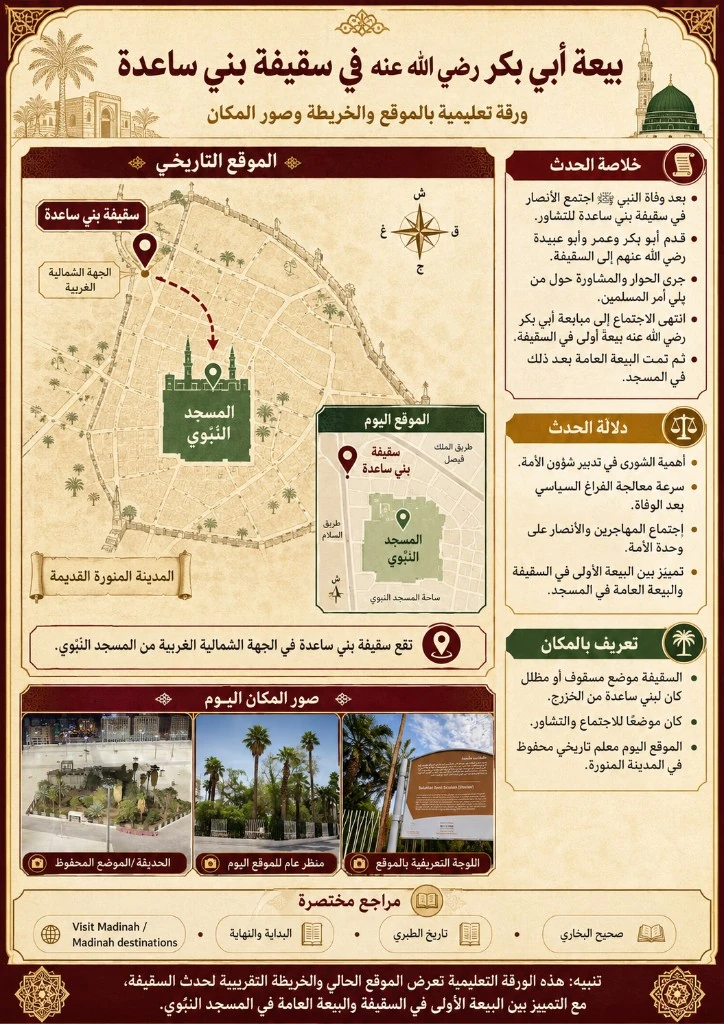
After the Prophet ﷺ died, the Muslims gathered to give allegiance to Abu Bakr may Allah be pleased with him so that he would be the caliph of the Muslims, meaning he would take charge of their affairs and lead them after the Prophet.
The death of the Prophet ﷺ and the Muslims’ need for someone to take charge of their affairs.
The Muslim community’s need for leadership to bring its affairs together after revelation ended and the Messenger died.
The Muslims’ leadership moved from prophethood to the caliphate.
It marks the beginning of the rightly guided caliphate after the death of the Prophet ﷺ.
It preserves the continuation of the call to Islam after revelation ceased.
It establishes the transfer of legitimate authority to the caliph.
It unites the Muslims under one leadership.
It teaches the ummah how to deal with a leadership vacuum through gathering and the pledge of allegiance.
It represents the founding of the system of governance in the Islamic state after prophethood.
It prevents division and ensures the continued management of the affairs of the Muslims.
the one given allegiance as caliph
gave allegiance to Abu Bakr as caliph
Faith requires steadfastness after the death of the Prophet ﷺ and holding fast to the truth.
Loyalty to the group and putting the public good first.
The importance of coming together and not splitting apart in times of hardship.
The need for a clear, legitimate leadership.
Teaching the الأمة that order does not stop with the death of the leader.
The need for an orderly mechanism for transferring leadership.
The beginning of the formation of the institutional Rashidun state.
The leadership vacuum after the founder or leader is gone.
The need to quickly come together around a trusted leader in times of crisis.
Setting clear mechanisms for transferring leadership.
Putting unity ahead of conflict during political transition.
Sticking with the community and obeying in what is right.
It is limited to the general lesson and does not equate the Rashidun caliphate with modern systems in every detail.
The prophetic context was a transition from prophethood to the caliphate in a community of revelation.
When leadership is absent, one should quickly choose a unifying legitimate leader.

