 المساعد الذكي
جارٍ تحميل القصة…

ز
مرحبًا زائرThe Prophet ﷺ ordered the burning of the Mosque of Dirar on his return from Tabuk, and it was burned
In Rajab of the ninth year, when the Prophet ﷺ returned from Tabuk, he ordered the Mosque of Dirar to be burned, and it was burned.

In Rajab of the ninth year, when the Prophet ﷺ returned from Tabuk, he ordered the Mosque of Dirar to be burned, and it was burned.
It is part of the events of the ninth year connected to the Prophet ﷺ’s return from Tabuk and the exposure of the hypocrites.
In Rajab of this year, and on his return - ﷺ - from Tabuk, he ordered the burning of the Mosque of Dirar, and it was burned.
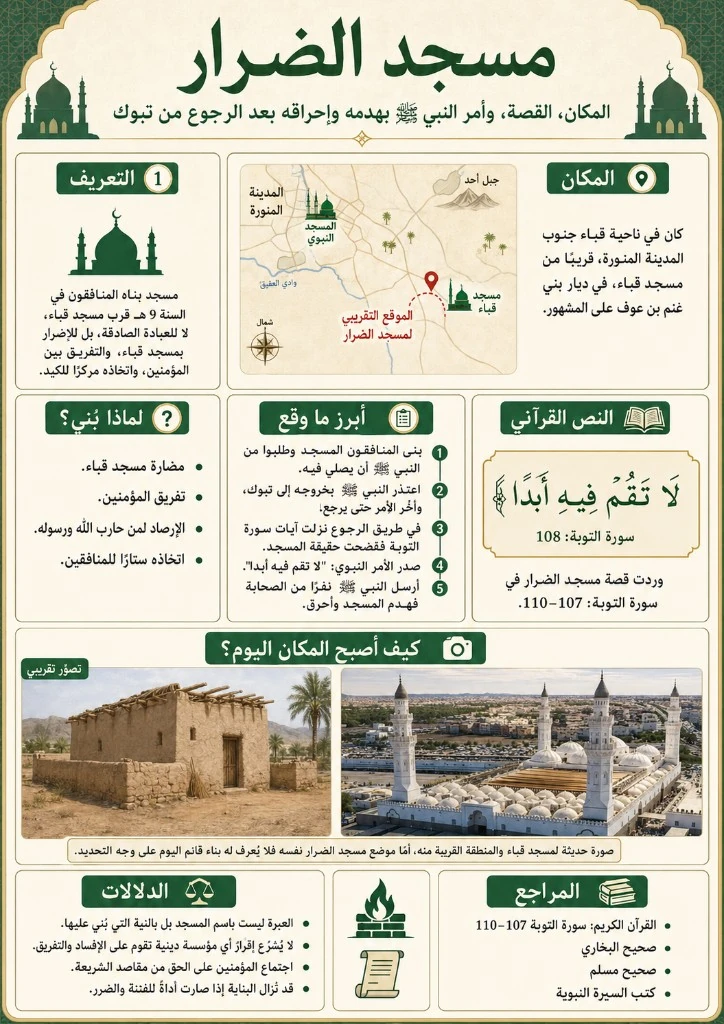
This means that the Prophet ﷺ ordered the Mosque of Dirar to be removed by burning after returning from Tabuk, and the order was carried out, so the mosque was burned.
The hypocrites built a mosque in the name of a mosque, and Allah commanded that their scheme and conspiracy be destroyed, and exposed them in verses from Surat at-Tawbah.
It was a mosque built by the hypocrites as a scheme and conspiracy, and the Quran exposed them.
The Mosque of Dirar ceased to exist after it was burned.
It is one of the events of Year 9 linked to exposing the hypocrites after Tabuk.
It shows that outward construction is not enough if the intent is corrupt.
It shows the Prophet's state taking a firm stance toward centers of conspiracy.
It protects society from places of discord and hypocrisy.
It teaches us to consider intentions, not appearances.
It shows that a religious civilization is not built on deceit.
Removing a place that could become a center for internal conspiracy.
Ordered the burning of the Mosque of Dirar
That Allah exposes hypocrisy and does not bless its structure.
Rejecting deception and hiding things in the name of religion.
Protecting the community from division and discord.
Not being lenient with structures set up to harm society.
Teaching the ummah that what matters is intention and purpose.
A religious institution is not accepted if it is a tool of corruption.
A true civilization is built on sincerity, not on disguise.
Using religious or social institutions or slogans for harmful or conspiratorial purposes.
Verify the real aims and functions of institutions before supporting them.
The need for transparency and sound intention.
Firmness with structures created to spread corruption under a lawful cover.
Not to be fooled by appearances when the intention is different.
Judgment should be drawn only within what is established, while taking into account differences in contexts and systems.
The Prophetic context was guided by revelation and infallible leadership, whereas the modern context needs legal and regulatory controls.
Any structure set up in the name of good and then used to cause harm must be dealt with in a way that removes its harm.

