 المساعد الذكي
جارٍ تحميل القصة…

ز
مرحبًا زائرA group of the Companions emigrates to Abyssinia with the permission of the Messenger of Allah ﷺ to protect their faith
A group of the Companions emigrated to Abyssinia with the permission of the Messenger of Allah ﷺ in the fifth year of the Prophetic Mission to protect their faith. Among them were Uthman ibn Affan, Az-Zubayr ibn al-Awwam, Abd ar-Rahman ibn Awf, and Ja'far ibn Abi Talib, and they stayed there for ten years.


قرار الهجرة إلى النجاشي بوصفه أول حماية دولية لجماعة مضطهدة.
A group of the Companions emigrated to Abyssinia with the permission of the Messenger of Allah ﷺ in the fifth year of the Prophetic Mission to protect their faith. Among them were Uthman ibn Affan, Az-Zubayr ibn al-Awwam, Abd ar-Rahman ibn Awf, and Ja'far ibn Abi Talib, and they stayed there for ten years.
It represents an early step in the Muslims' move from a stage of weakness to seeking a safe refuge for the call to Islam and worship.
In the fifth year of the Prophetic Mission, a group of the Companions emigrated to Abyssinia (Habashah), with the permission of the Messenger of Allah ﷺ, to protect their faith. Among them were Uthman ibn Affan, Az-Zubayr ibn al-Awwam, Abd ar-Rahman ibn Awf, and Ja'far ibn Abi Talib. They stayed there for ten years.
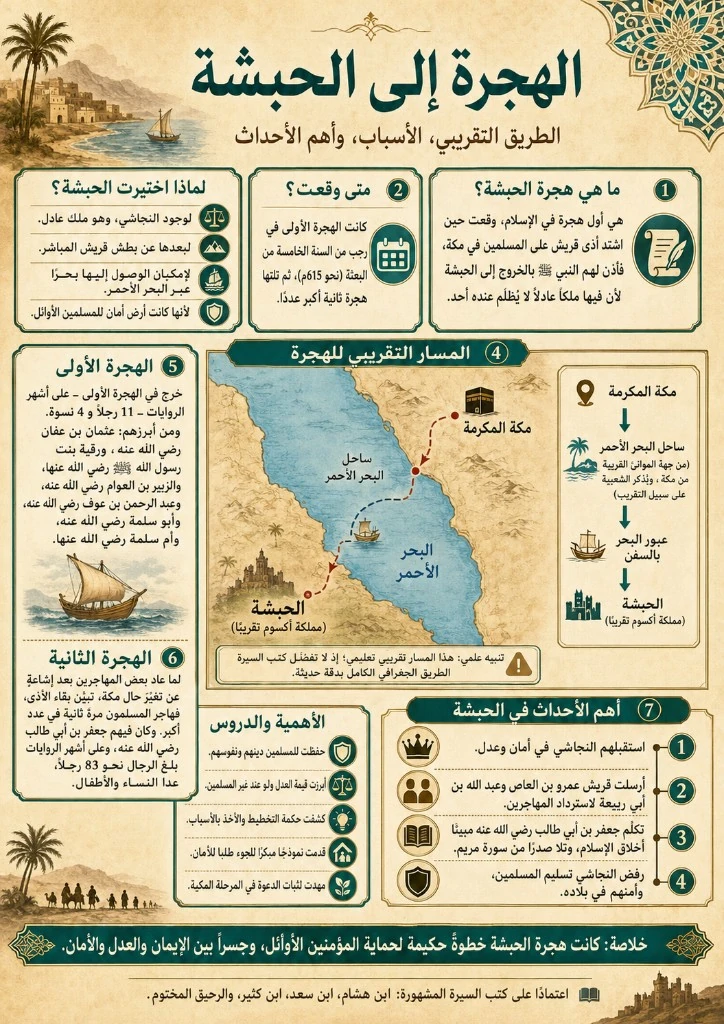
When the harm against the Muslims in Makkah became severe, the Prophet ﷺ gave them permission to go to Abyssinia so they could protect their faith and worship Allah in safety. A number of the Companions went there and stayed for a long time.
The harm against the Muslims in Makkah intensified, and the need appeared for a safe place where they could worship Allah.
The attacks on the Muslims in Makkah intensified, and they sought a safe place for worship.
Some Muslims moved from the harmful environment in Makkah to a safer environment in Abyssinia.
One of the earliest forms of Hijrah in Islam.
Preserving a group of believers so they could continue to hold fast to the religion.
Finding a refuge outside Makkah for the oppressed.
Relieving some Muslims from the suffering caused by harm.
Teaching believers that preserving religion comes before attachment to place.
Showing the value of seeking safety and justice to protect people.
Protecting the core group of Muslims from being wiped out.
He gave the Muslims permission for The emigration to Abyssinia
One of those who emigrated to Abyssinia (Habashah)
One of those who emigrated to Abyssinia (Habashah)
One of those who emigrated to Abyssinia (Habashah)
One of those who emigrated to Abyssinia (Habashah)
Relying on Allah while taking the means to preserve religion.
Patience, steadfastness, and putting principle before comfort.
Solidarity in facing collective harm.
Seeking a safe environment when safety is no longer possible at home.
Training believers to sacrifice for the creed.
That protecting religious freedom is a foundation of human civilization.
People being persecuted because of their religion or prevented from practicing their rites.
If preserving religion becomes impossible in a place, seeking a safe environment is permissible.
The need to provide protection and support for the oppressed.
The importance of safeguarding freedom of religion and security for citizens.
To remain firm in his religion and take practical steps when faced with trial.
It is limited to the general meaning, without unfounded applications.
The Prophetic context was at the start of the call to Islam and under direct harm from Quraysh.
Protecting religion takes priority over staying in a place when safety is not possible.

