 المساعد الذكي
جارٍ تحميل القصة…

ز
مرحبًا زائرThe end of the siege of Ta'if in the last part of Shawwal of Year 8 after the Hijrah (8 AH), then the Prophet ﷺ returned to al-Ji'ranah, and the delegation of Hawazin came to him after embracing Islam, and he returned the captives to them
The Messenger of Allah ﷺ lifted the siege of Ta'if after a long siege, then returned to al-Ji'ranah. There the delegation of Hawazin came to him after they had embraced Islam, and he returned the captives who were with the Muslims to them.

The Messenger of Allah ﷺ lifted the siege of Ta'if after a long siege, then returned to al-Ji'ranah. There the delegation of Hawazin came to him after they had embraced Islam, and he returned the captives who were with the Muslims to them.
It marks the end of a phase of the Battle of Hunayn and Ta'if, and the beginning of dealing with its political and social outcomes.
And in the last part of Shawwal of this year: the Messenger of Allah - ﷺ - lifted the siege of Ta'if, then returned to al-Ji'ranah, and the delegations of Hawazin came to him after they had embraced Islam, so he returned their captives to them.
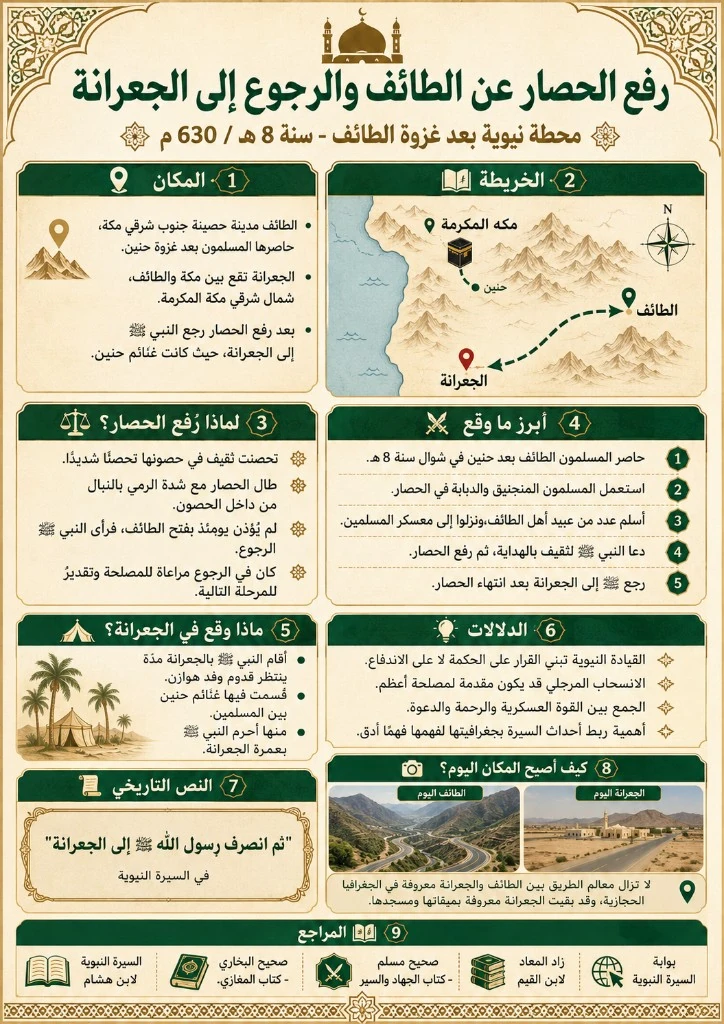
After the siege of Ta'if had gone on for a long time and the Prophet ﷺ saw what hardship the Muslims were facing, he decided to lift the siege and return. Then he stayed at al-Ji'ranah. After that, the delegation of Hawazin came to him as Muslims, and as a result he returned the captives to them.
This event was preceded by the siege of Ta'if after the Battle of Hunayn, and by the spoils and captives remaining at al-Ji'ranah until the matter of Ta'if was finished.
The end of the military confrontation with the people of Ta'if, then the appearance of the delegation of Hawazin after they had embraced Islam and their request for the captives who were with the Muslims.
The Muslims moved from the stage of siege and fighting to the stage of receiving delegations and dealing with the spoils and captives.
It marks the end of the siege of Ta'if and the effects that followed the Battle of Hunayn.
It shows the effect of Islam when the delegation of Hawazin came as Muslims.
It shows how the Prophet ﷺ managed the results of war and received delegations.
It reflects the shift from fighting to reconciliation and returning the captives.
It teaches wisdom, patience, and good conduct in dealing with the results of conflict.
It shows that war in Islam is not an end in itself, and that its effects are managed with justice and mercy.
It shows sound judgment when a siege lasts a long time and then moves to another stage.
He lifted the siege, then returned to al-Ji'ranah, received the delegation of Hawazin, and ordered the captives to be returned
They came to the Prophet ﷺ after embracing Islam
That victory and guidance are in Allah's hands, and that turning to Islam changes outcomes.
Mercy and fairness in returning the captives.
The possibility of rebuilding the relationship after conflict.
Good management of the aftermath of war and receiving delegations.
Teaching patience and not rushing in military situations.
The existence of an orderly decision in dealing with the captives and delegations.
Turning tribal conflict into a relationship based on Islam and justice.
Managing the effects of conflicts after they end and how to move from enmity to reconciliation.
The need to combine firmness and mercy when crises end.
Organizing dealings with delegations and humanitarian cases after conflicts.
The importance of ending conflict with decisions that preserve dignity and open the door to reconciliation.
Learning that circumstances change, and that mercy may be in the place of strength.
It is not right to apply the details of battles and prisoners to every modern situation without considering the different context.
The Prophetic context was within revelation, Prophetic leadership, and an ongoing war, whereas the modern context has different systems and laws.
When conflict ends, the public good and disciplined mercy take priority over continued hostility.

