 المساعد الذكي
جارٍ تحميل القصة…

ز
مرحبًا زائرThe Prophet's ﷺ witnessing of The Pact of al-Fudul in support of the oppressed
The Prophet ﷺ witnessed The Pact of al-Fudul, in which tribes of Quraysh agreed to support the wronged and repel injustice from him. This took place in the house of Abdullah ibn Jud'an.


أقدم ميثاق لنصرة المظلوم، وصداه في فكرة العدالة الدولية اليوم.
The Prophet ﷺ witnessed The Pact of al-Fudul, in which tribes of Quraysh agreed to support the wronged and repel injustice from him. This took place in the house of Abdullah ibn Jud'an.
It is an early example of the Prophet's ﷺ stands for justice and support for the oppressed before the beginning of revelation.
Then he ﷺ witnessed The Pact of al-Fudul in support of the oppressed.
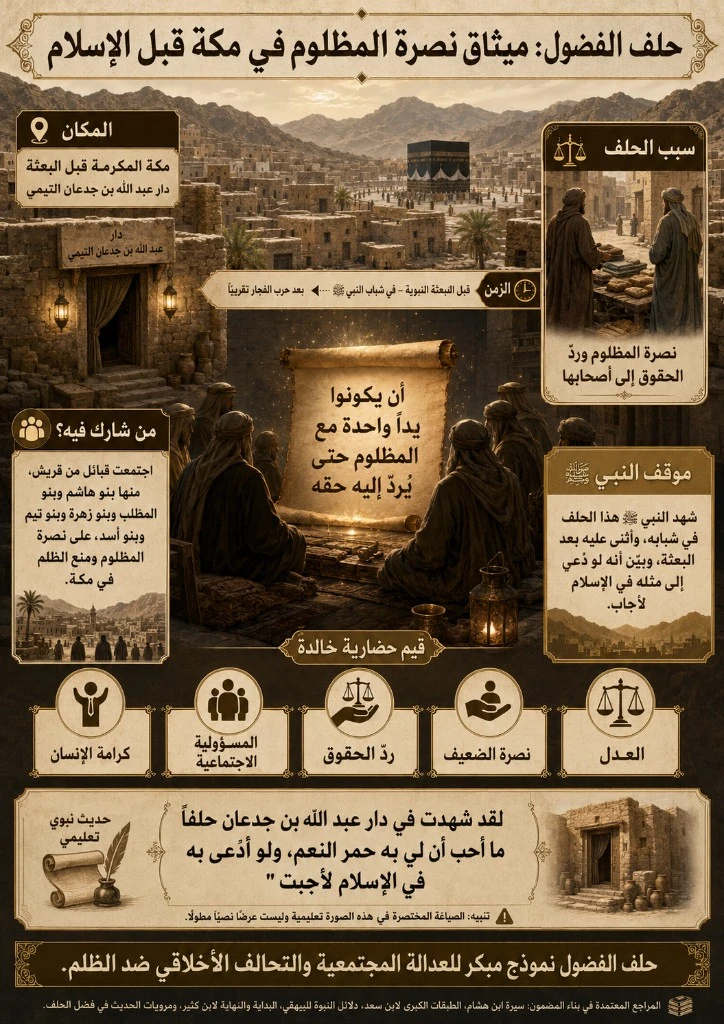
Tribes from Quraysh gathered in Makkah and agreed that they would not leave any oppressed person, whether from the people of Makkah or others, without standing with him until he received his right. The Prophet ﷺ was present at this pact.
The pact came after the Fijar War, in a social setting where tribal loyalty was strong. A man from Zubayd was wronged in Makkah, so he cried out for help.
The need to support the oppressed and push back injustice in a society where tribal loyalty could outweigh justice.
The oppressed in Makkah now had social support, and a collective stand appeared that rose above some forms of pre-Islamic tribal partisanship.
A well-known event from before the Prophet’s mission, in which the Prophet ﷺ witnessed a covenant to support the oppressed.
It highlights Islam’s harmony with the values of justice and supporting the oppressed.
It shows a form of social organization to confront injustice in Makkah.
It established the value of cooperation in restoring rights.
It teaches standing with the truth even in a society ruled by tribal partisanship.
It shows the Makkan society’s ability to adopt a unifying moral principle.
It helped build a moral reputation for the Prophet ﷺ before the mission.
He witnessed the pact
The people gathered in his house
He withheld the Zubaydi man's right
An oppressed man who sought help against the one who wronged him
Love of justice and support for the oppressed are values affirmed by the truth.
Faithfulness to what is right and standing against injustice.
The possibility of forming social alliances to protect the weak.
Social authority can be used to repel injustice.
Restoring financial rights to their owners.
Teaching the young that dignity lies in supporting the oppressed.
The need for a covenant or collective mechanism to protect rights.
Justice is the foundation of social development.
Injustice and the absence of fairness in some social or institutional settings.
Cooperating to protect rights and restore wrongs.
Building covenants and mechanisms to support the oppressed.
Strengthening social justice and protecting the vulnerable.
He should not stay silent about injustice, and should support the truth as much as he can.
It is limited to the general meaning of justice and supporting the oppressed, without unsupported applications.
The alliance was a tribal initiative in Makkah, while today there are broader institutions and laws.
Any covenant or initiative that supports the oppressed and restores rights is among the meanings affirmed by this event.

