 المساعد الذكي
جارٍ تحميل القصة…

ز
مرحبًا زائرThe Expedition of the Messenger of Allah ﷺ against Banu Sulaym in Shawwal of Year 2 after the Hijrah (2 AH) as far as al-Kudr
The Messenger of Allah ﷺ went out in Shawwal of Year 2 after the Hijrah (2 AH) to Banu Sulaym, until he reached al-Kudr. It was part of the military activity that took place after Badr and in the context of strengthening the emerging Islamic state.
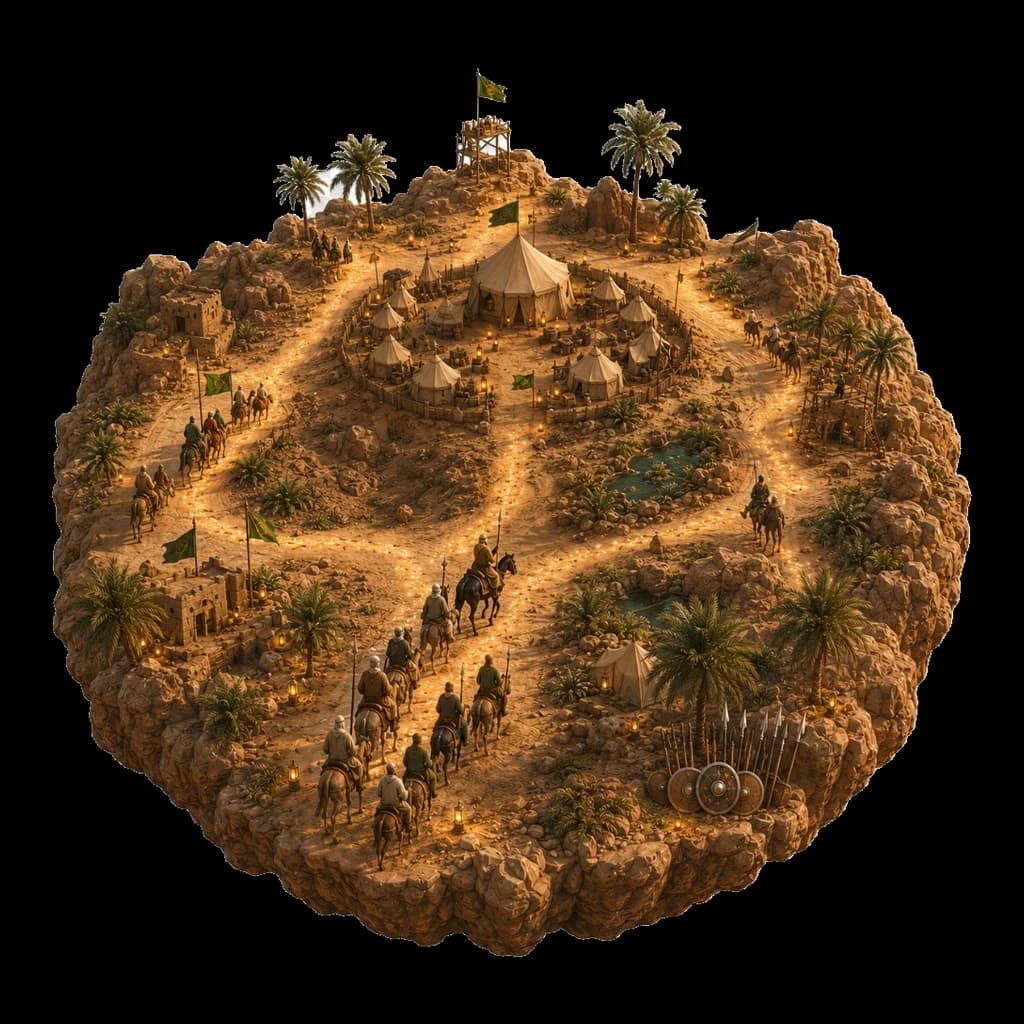
The Messenger of Allah ﷺ went out in Shawwal of Year 2 after the Hijrah (2 AH) to Banu Sulaym, until he reached al-Kudr. It was part of the military activity that took place after Badr and in the context of strengthening the emerging Islamic state.
It falls within the stage of building the military strength of the Islamic state in Madinah.
And in Shawwal of this year: the Messenger of Allah ﷺ led a ghazwah against Banu Sulaym as far as al-Kudr.
What is meant is that the Prophet ﷺ led a campaign to Banu Sulaym and reached al-Kudr.
This ghazwah took place in Year 2 after the Hijrah (2 AH), the year that saw military activity after Badr.
No specific change is mentioned after it.
It documents military activity in Year 2 after the Hijrah (2 AH).
It shows the presence of the emerging Islamic state in the surrounding tribal sphere.
It teaches the sequence of events and not to go beyond the evidence in drawing conclusions.
It shows the shift of the call to Islam to a stage of organizing power and field presence.
It represents a military movement toward a specific location as part of managing the area around Madinah.
Leader of the ghazwah
The side toward which the ghazwah was directed
Relying on the Prophet ﷺ's leadership in directing the public movement.
Precision in presentation and not adding what is unproven.
Continuing to deal with tribes as influential social units.
The Islamic state's authority in directing raids becomes clear.
Training the learner to keep historical information accurate.
There is organized leadership decision-making in managing raids.
The Muslim community turns into an organized entity with military and political movement.
Managing security and field presence around the state or society.
The importance of clear leadership and defining the goal in any collective action.
The need to document events accurately and not go beyond the texts.
The importance of planning and organized movement when needed.
Discipline with documented information and avoiding guesswork.
It is not correct to project unstated modern details onto the event.
The prophetic context is tied to revelation and the building of the first state, while the modern context has different systems and considerations.
Judgment or understanding should be based only on a verified text and documented information.

