 المساعد الذكي
جارٍ تحميل القصة…

ز
مرحبًا زائرPeace settlement with the Jews of Tayma with the Messenger of Allah ﷺ and their staying with their property
When the Jews of Tayma heard the news of what had happened to the Jews in Khaybar, Fadak, and Wadi al-Qura, they did not resist the Muslims. Instead, they sent word offering peace, so the Messenger of Allah ﷺ accepted it and left them in possession of their property.

When the Jews of Tayma heard the news of what had happened to the Jews in Khaybar, Fadak, and Wadi al-Qura, they did not resist the Muslims. Instead, they sent word offering peace, so the Messenger of Allah ﷺ accepted it and left them in possession of their property.
It falls within the effects of the Conquest of Khaybar and the resulting submission of some neighboring Jewish groups to peace.
When the Jews of Tayma learned what had happened to their brethren in Khaybar, Fadak, and Wadi al-Qura, they made peace with the Messenger of Allah ﷺ and stayed with their property.
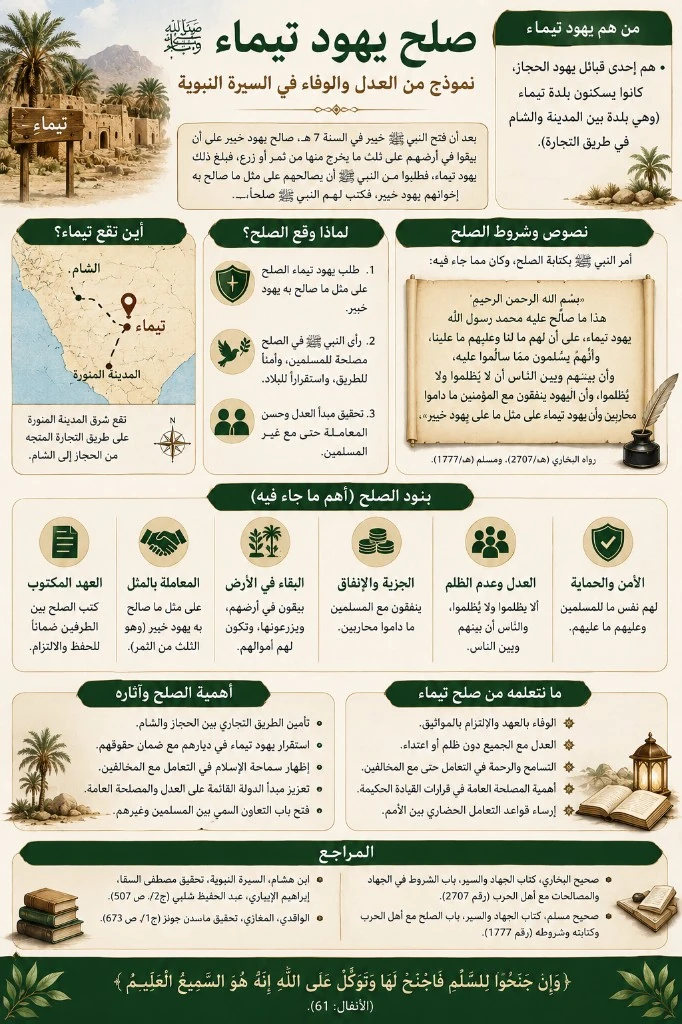
The Jews of Tayma were afraid after what happened to their brethren in the nearby areas, so they chose peace instead of confrontation. The Prophet ﷺ accepted that, and they stayed in their land and kept their property.
Before this event came what happened in Khaybar, Fadak, and Wadi al-Qura, where there was surrender or peace settlement, and that affected the position of the Jews of Tayma.
The balance of power changed after the events of Khaybar and what followed, which pushed them to seek peace.
The position of the Jews of Tayma shifted from the possibility of resistance to peace and keeping their property.
Documents the impact of the conquest of Khaybar and what followed on the nearby Jewish communities.
Shows that reconciliation is accepted when it serves a benefit and prevents fitna.
Reflects the spread of Islamic influence in northern the Hijaz.
Confirms the possibility of organizing relations with non-Muslim groups through reconciliation.
Teaches the value of considering outcomes and choosing peace when needed.
Shows the region moving into a state of relative political stability.
Reduces centers of tension around Khaybar and nearby areas.
Accepted the peace settlement and left them in possession of their property
Sought peace and stayed with their property
Victory from Allah changes the balance of power.
Reconciliation is better than confrontation when it is possible.
The possibility of organizing coexistence with other groups through a clear agreement.
Wise leadership makes use of the results of events without expanding the fighting.
Leaving them their property shows the protection of ownership within reconciliation.
Teaching Muslims that strength does not prevent justice and keeping a covenant.
A form of reconciliation that preserves rights and regulates the relationship.
Building stability through agreements instead of continual clash.
Some groups or parties choose negotiation after conditions change instead of escalation.
A realistic response to changing circumstances may prevent greater losses.
The importance of managing relations through clear agreements and protecting rights.
Choosing peaceful solutions when they are more beneficial and less harmful.
To balance strength and wisdom when dealing with crises.
This event should not be measured against every modern conflict without considering the legal and historical context.
The Prophetic context was one of building a state, revelation, and legislation, while the modern context is governed by different systems and realities.
If rights can be preserved and conflict ended through a documented reconciliation, that is better than escalation.

