 المساعد الذكي
جارٍ تحميل القصة…

ز
مرحبًا زائرHe sent Muhayyisah ibn Mas'ud to the Jews of Fadak to invite them to Islam. They made a peace settlement with the Prophet ﷺ for half of the land, and he accepted from them. Half of Fadak became his exclusive property because the Muslims had not made any mounted charge against it with horses or camels.
After leaving Khaybar, the Prophet ﷺ sent Muhayyisah ibn Mas'ud to Fadak to invite its people to Islam. They agreed to peace over half the land, and he accepted that from them, so half of Fadak became exclusively his, and he spent from it on wayfarers.

After leaving Khaybar, the Prophet ﷺ sent Muhayyisah ibn Mas'ud to Fadak to invite its people to Islam. They agreed to peace over half the land, and he accepted that from them, so half of Fadak became exclusively his, and he spent from it on wayfarers.
It falls within organizing the post-Khaybar situation and handling relations with the Jews of neighboring areas
And when the Messenger of Allah - ﷺ - had left Khaybar, he sent Muhayyisah ibn Mas'ud to Fadak to invite them to Islam. So they made peace with the Messenger of Allah - ﷺ - over half the land, and he accepted that from them. Half of Fadak then became exclusively for the Messenger of Allah - ﷺ - because the Muslims had not driven horses or camels against it, so he would spend what came to him from it on wayfarers.
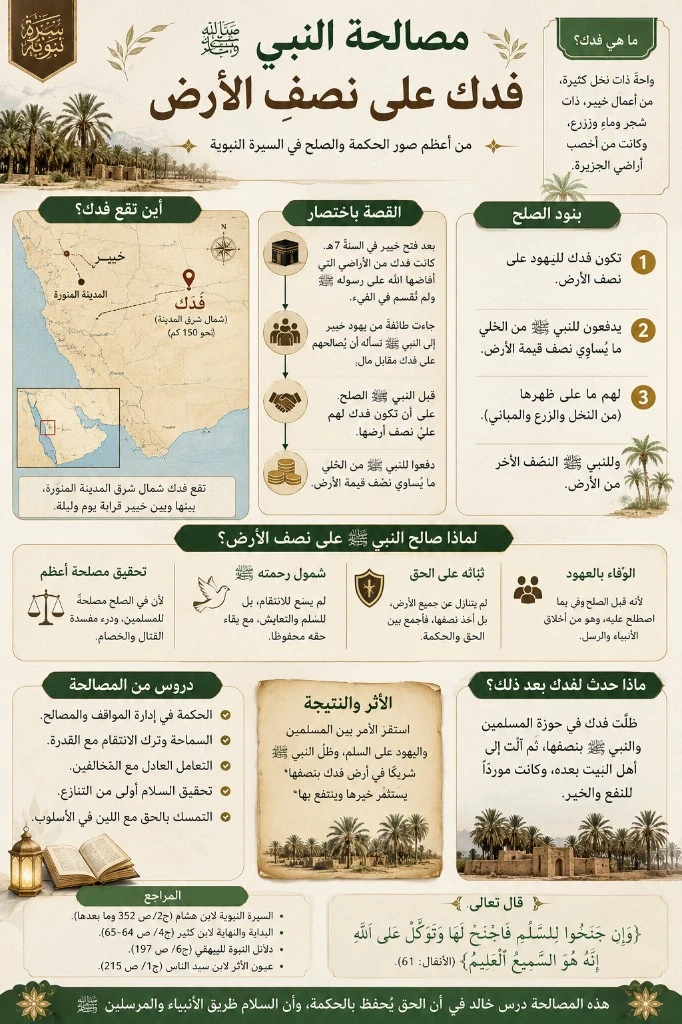
What is meant is that the Prophet ﷺ sent someone to invite the people of Fadak to Islam. When the Muslims did not fight them, they made a peace agreement that half the land would be theirs and half would belong to the Prophet ﷺ, because the Muslims had not conquered Fadak by fighting or by dispatching cavalry or camels.
This was after leaving Khaybar, and in the context of what happened in dealing with the Jews of the region after Khaybar was conquered.
The arrangement of relations with Fadak after Khaybar, and the fact that it was not taken in direct fighting, meant that half of it belonged exclusively to the Prophet ﷺ.
Fadak moved into a peace agreement status, and the Prophet ﷺ had half of it exclusively, to be spent on the mentioned public interests.
Documents the arrangement of Fadak after Khaybar
Shows the call to Islam before reconciliation
Organizes the relationship with a neighboring area without fighting
Directs Fadak's resources to travelers in need
Teaches acceptance of reconciliation and fairness in dealings
Shows how public resources are managed
Confirms consolidating the aftermath of Khaybar by peaceful means
Sent Muhayyisah ibn Mas'ud to Fadak and accepted the peace agreement
A messenger to Fadak inviting them to Islam
Made peace with the Prophet ﷺ on half the land
Moving with the call to Islam before any other arrangement
Accepting reconciliation and not تجاوزing the truth
Directing resources to travelers in need
Managing relations with neighboring groups through reconciliation
The existence of a financial resource to be spent on public interests
Teaching that public wealth has useful uses
Organizing resources after the Conquest
Bringing land and wealth into a disciplined system
Managing resources and land after conflicts
The call to Islam and reconciliation first, then organizing financial rights clearly
Managing endowments and public resources transparently
Offering peaceful solutions in financial and land disputes
Committing to justice in wealth and rights
This event should not be applied to every modern dispute without considering the legal and historical context
The decision was made in the context of revelation, Prophetic leadership, and the circumstances of the Khaybar campaign
If fair reconciliation is possible while preserving rights, it is better than escalation

